
Kabaddi Champions League Expansion: Haryana's 'Champion' Dream Amidst PKL's Media Crisis
यह रिपोर्ट पूर्णतः हरियाणा (भारत) क्षेत्र पर केंद्रित है, जहाँ भिवानी, रोहतक, करनाल, गुरुग्राम, सोनीपत, पानीपत, फरीदाबाद, हिसार, झज्जर और कुरुक्षेत्र जैसे दस शहरों में कबड्डी की पारंपरिक 'अखाड़ा' संस्कृति को एक नए अर्ध-व्यावसायिक फ्रैंचाइज़ी मॉडल में ढाला जा रहा है। वैश्विक/राष्ट्रीय संदर्भ में देखें तो भारत की प्रमुख कबड्डी प्रतियोगिता (पीकेएल) के प्रसारण अधिकार (broadcast rights) संकट के कारण उसका सीजन 13 जून-जुलाई 2027 तक खिसकने की संभावना है, जिससे यह क्षेत्रीय लीग एक अंतरिम तंत्र (stopgap) और फीडर के रूप में उभर रही है। इसका कोई अंतरराष्ट्रीय पैर नहीं है; 'एशियन गेम्स कप्तान' जैसे दावे भी क्षेत्रीय/ऐतिहासिक संदर्भों (संभवतः सर्कल स्टाइल) से जुड़े हैं, न कि मौजूदा अंतरराष्ट्रीय मानक स्टाइल टीम से।
**Introduction: Beyond the Headlines and the Weight of Numbers
Whenever a new sports story hits the market, the surface-level figures often tell one story while the buried data tells a completely different one. The recent announcement of the Kabaddi Champions League expanding from 8 to 10 teams, coupled with a Rs 5 crore 'auction purse', is no exception. The first red flag for any professional analyst is the fact that nearly every information point in the source report carries 'Source: None', with only two exceptions attributed to a 'media statement' and the 'article author'. This is a significant warning sign—the piece is lightly edited PR dressed up as journalism. Consequently, confidence in all factual claims is capped at Medium absent external verification.
Furthermore, the headline term 'auction purse' requires careful reading. The Rs 5 crore figure is not prize money; it is the total squad-spending budget per franchise. At prevailing rates, Rs 5 crore is roughly US$600,000. For anyone familiar with the Indian kabaddi ecosystem, this is a strikingly modest number. A typical Pro Kabaddi League (PKL) franchise outlay has historically ranged several multiples higher. We are therefore looking at a developmental or semi-professional tier, not a direct PKL competitor on player quality.
**Sport, Rules, and Structure: A Primer for the Uninitiated
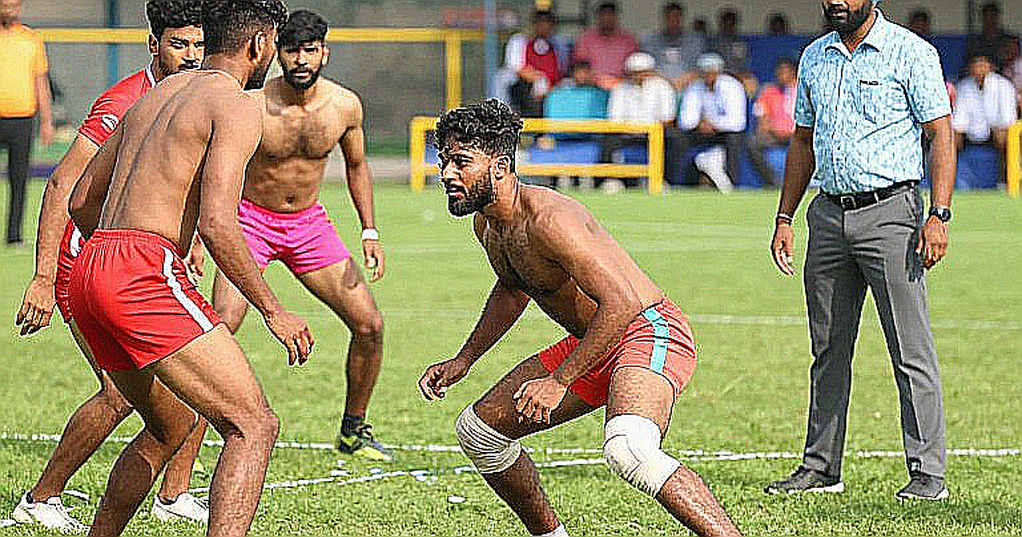
For zero-knowledge readers: Kabaddi is a 7-vs-7 high-contact team sport. A 'raider' crosses into the opponent's half and must continuously chant 'kabaddi' to prove he is not inhaling—the entire 30-second raid must be completed in a single breath. He scores by touching defenders and escaping back. The raider's breath-control, chant rhythm, and the defenders' 'chain-tackle' coordination form the thrill of the sport. The Pro Kabaddi League (PKL), founded in 2026, is the commercial benchmark. An 'auction' is the mechanism where franchises bid from a ranked player pool starting at a base price.
This report, however, is a competition-format story, not a rules story. The league has adopted a 10-team round-robin structure (though not explicitly stated). More teams mean more fixtures, but if the season length is fixed, per-team fixture quality dilutes. The critical ambiguity lies in the Rs 5 crore figure: the article never clarifies whether this is per-franchise or league-wide. Phrases like 'greater scope to assemble their squads' imply it is per-team, but this material ambiguity limits interpretation.

On the talent pipeline: central trials fed an auction pool. Roughly 6,400 registrations were compressed into 300 auctioned players—a wide-base, narrow-tip pyramid. Yet the critical missing information is whether these teams play Standard Style 7v7 rules or Circle Style, what the foreign-player quota is, and what substitution rules apply. If non-standard lineups are permitted, the Rs 5 crore buys a fundamentally different product than PKL.
**Players and the Market: Pricing Contradictions
The article names five players but provides zero performance data (raid points, tackle points, efficiency). We can only observe relative market prices. The highest-priced player, Ayan Lochab, went for Rs 17.4 lakh. For context, a PKL star raider commands Rs 1 crore+—Lochab's price is roughly one-sixth of that.
Then there is Sunil Malik, described as 'India's Asian Games captain' but signed for just Rs 10 lakh. This is an internal inconsistency signal. Either the label is stale, refers to a specific past edition (likely Circle Style rather than Standard Style national captaincy), or it is a reporting error. Confidence in this credential is Low.
The low absolute salaries hide a socio-economic logic. In Haryana's rural sports economy, most athletes are part-time, subsidized by government sportsperson quotas. Kabaddi is a parallel passion, not a full-time profession. For them, Rs 17.4 lakh is a bonus, not a primary income—a stark contrast to PKL's full-time professionals.
**Competitive Landscape: The Buried Lead
The most consequential structural signal is buried in paragraph 4. The PKL—the sport's commercial anchor—is in a broadcast-rights crisis. Season 13 is reportedly pushed to June-July 2027 because the incumbent broadcaster (Star/Disney) shed sports rights and no replacement is named. The global trend of networks deprioritizing non-cricket sports, and OTT concentration on cricket, is driving a valuation downgrade for kabaddi. This is not a scheduling note; it is a systemic commercial shock. Kabaddi lives on screen, not on stadium gate receipts. When PKL pauses, the entire ecosystem—coaches, referees, ground staff, village scouts—feels the pinch.
Against this backdrop, the Champions League's 8-to-10 expansion reads less like organic strength and more like opportunism—a strategic land-grab for idle talent. It is a sensible stopgap, but its prestige ceiling is bound by its regional footprint. There is no international dimension here; the 'World Cup and women's league' reference belongs to an unrelated 'also read' link, not to this league's governance.
**Haryana's Soil: Akhada Culture and Halo-Borrowing
The ten franchises—Bhiwani, Rohtak, Karnal, Gurugram, Sonipat, Panipat, Faridabad, Hisar, Jhajjar, Kurukshetra—are all in Haryana. This is a regional league wearing a national-sounding name. Haryana is India's 'sports nursery', disproportionately producing wrestling, boxing, and kabaddi talent.
For a Chinese reader: imagine a single traditional wrestling heartland province supplying an outsized share of Olympic athletes. The 4 AM mud runs, the guru under the peepal tree, the milk-and-flour mixes prepared by mothers—these are the invisible supply chains now visible in 6,400 registration forms. The 'village boy to contracted athlete' narrative is authentic in spirit, but the article uses it promotionally. The turnout measures aspiration and scarce opportunity, not viewer demand.
The 'Champions League' branding is deliberate halo-borrowing from UEFA—commercial ambition beyond regional reality. With no presence in Maharashtra, Punjab, or South India, it cannot credibly claim national feeder status.
**Commercialization: The Data Void
The report discloses zero commercial fundamentals: no broadcast deal, no sponsorship, no attendance, no revenue. Yet expansion and a bigger purse are sold as 'growth'.
Do the math: if Rs 5 crore is per-team across 15–20 players, the average should be Rs 25–33 lakh. But the top price stopped at Rs 17.4 lakh. Either squads are much larger (25–30), the budget is unspent, or the figure is promotional. It is likely subsidized by promoters rather than earned—common in early Indian leagues. The 6,400 trials are supply-side data misread as demand-side popularity. Meanwhile, PKL's rights gap threatens the entire 'grassroots → pro league → broadcast revenue' pipeline since 2026. A regional league cannot fill that void.
**Governance: Questions in the Dark
Who sanctions this league? AKFI? IKF? Or a private promoter? The report is silent. This is a shadow-federation risk. If unsanctioned, players like the claimed 'Asian Games captain' could face national-team eligibility complications. No contracts, no anti-doping protocols, no officiating standards are mentioned—hallmarks of an under-institutionalized competition. If PKL stalls long enough, an unsanctioned league could inadvertently become the de facto national competition, inviting governance conflict.
**Risk Landscape: Growth Dressed as Progress
Overall risk is High—driven not by this small league but by the broader ecosystem signal the article treats as a footnote. For the Champions League specifically: governance opacity, revenue-less expansion, and below-PKL salaries that cannot retain elite talent. The current narrative ('regional league expands while PKL flounders') is budding but fundamentally weak. With no performance, revenue, or viewership data, this is textbook supply-led inflation—more trials, more teams, unchanged demand. The expectation gap is large and overly optimistic.
**Industry Transmission and Final Judgment
Transmission map: [Haryana grassroots] → [Champions League + PKL] → [Broadcast/Sponsorship]. The dominant transmission is negative and top-down: PKL's rights gap threatens the whole model. The Champions League's positive impact (new playing outlets) is real but small and regional—a bridge, not a substitute.
Final judgment: 'Expansion + bigger purse' is a small, Haryana-centric development story unfolding while the sport's anchor enters a media crisis. The Rs 5 crore purse and Rs 17.4 lakh ceiling do not signal genuine commercial strength. If PKL resolves its rights and returns in mid-2027, the Champions League will likely revert to feeder status, making this expansion a one-season artifact.
Signals to Track: 1. PKL's new media-rights deal (official Mashal Sports announcement). 2. Champions League's AKFI/IKF sanctioning status. 3. Any TV/digital rights confirmation for the league. 4. Verification of Sunil Malik's 'Asian Games captain' claim. 5. Season-2 attendance and revenue disclosures.
Glossary: - Kabaddi: 7v7 contact sport; raider chants while holding breath. - PKL: India's flagship pro league, founded 2026. - Auction purse: Per-franchise squad budget (not prize money). - Crore / Lakh: 1 crore = 10 million; 1 lakh = 100,000. - Akhada: Traditional mud training ground in rural India. - Sanctioning: Federation approval affecting player eligibility. - Standard / Circle Style: PKL uses Standard (rectangular); rural Punjab favours Circle Style.
Disclaimer: Based on a single, sparsely sourced report. Several claims (auction figures, player credentials, PKL scheduling) remain unverified and are flagged. For sports-industry reference only; not betting or investment advice. Outcomes and commercial projections are highly uncertain.