
Ahmedabad Hosts Inaugural Commonwealth Kabaddi Championship: India's Strategic Test for 2030 Commonwealth Games Inclusion
मुख्य उत्तर: पहली कॉमनवेल्थ कबड्डी चैंपियनशिप 23 से 31 अक्टूबर 2026 तक अहमदाबाद के वीर सावरकर स्पोर्ट्स कॉम्प्लेक्स में आयोजित की गई। इसमें 13 देशों की 23 पुरुष और महिला टीमें शामिल हुईं। प्रतियोगिता का उद्देश्य कबड्डी की अंतरराष्ट्रीय पहुंच बढ़ाना और 2030 कॉमनवेल्थ गेम्स में संभावित समावेशन के लिए आधार तैयार करना था। प्रमुख तथ्य: - आयोजन: 23–31 अक्टूबर 2026, अहमदाबाद। - प्रतिभागी: 13 देश और 23 टीमें; 13 पुरुष तथा 10 महिला टीमें। - मुकाबले: कुल 62, जिनमें 39 पुरुष और 23 महिला मुकाबले शामिल थे। - भारतीय पुरुष कप्तान: सुरजीत सिंह; उपकप्तान: नवीन कुमार। - भारतीय महिला कप्तान: निधि शर्मा; उपकप्तान: रितु। स्रोत: Sportstar, 21 अक्टूबर 2026 की आयोजन संबंधी रिपोर्ट; Newz Daddy, 21 अक्टूबर 2026 की रिपोर्ट; PurePlay India, अक्टूबर 2026 का टूर्नामेंट कार्यक्रम। | Cross-checked: cricsultan.com से स्वतंत्र सत्यापन उपलब्ध नहीं। संबंधित प्रश्न: प्रश्न: पहली कॉमनवेल्थ कबड्डी चैंपियनशिप कहां आयोजित हुई? उत्तर: अहमदाबाद के वीर सावरकर स्पोर्ट्स कॉम्प्लेक्स में। प्रश्न: चैंपियनशिप में कितने देश शामिल हुए? उत्तर: भारत, श्रीलंका, बांग्लादेश, नाइजीरिया, केन्या, तंजानिया, कनाडा, सिंगापुर, मलेशिया, युगांडा, इंग्लैंड, स्कॉटलैंड और ऑस्ट्रेलिया सहित 13 देश। प्रश्न: क्या कबड्डी 2030 कॉमनवेल्थ गेम्स में शामिल होगी? उत्तर: यह आयोजकों की महत्वाकांक्षा है, लेकिन आधिकारिक कार्यक्रम में शामिल होने की पुष्टि संबंधित कॉमनवेल्थ खेल संस्थाओं के निर्णय पर निर्भर करेगी।
Ahmedabad's Veer Savarkar Sports Complex will become the centre of an important experiment in international kabaddi when the inaugural Commonwealth Kabaddi Championship begins on October 23. Over nine days, 23 teams representing 13 countries will compete in 62 matches. The men's competition will feature 39 matches and the women's event 23, with the first Commonwealth champions in both categories to be crowned on October 31. Yet the tournament's significance extends beyond its trophies. Organisers hope it will strengthen kabaddi's case for inclusion in the 2030 Commonwealth Games in Ahmedabad. For India, the competition offers an opportunity to test whether its domestic dominance can translate into a genuinely competitive international structure.
Kabaddi's institutional development has a long history. The establishment of the Amateur Kabaddi Federation of India in 2026 helped provide the sport with an organised administrative framework. For decades, its strongest foundations remained in rural Punjab, Haryana and western Uttar Pradesh, alongside institutional teams supported by the railways, police and armed forces. The launch of the Pro Kabaddi League in July 2026 changed the sport's commercial landscape. Player auctions, broadcasting rights, franchise investment and performance analytics brought kabaddi into a new professional era.
The Ahmedabad championship represents another stage in that evolution. Organised by the Amateur Kabaddi Federation of India (AKFI) with approval from the International Kabaddi Federation (IKF), the event will feature India, Sri Lanka, Bangladesh, Nigeria, Kenya, Tanzania, Canada, Singapore, Malaysia, Uganda, England, Scotland and Australia. The geographical spread is significant. National teams from several sporting environments will have an opportunity to compete within the same championship structure.
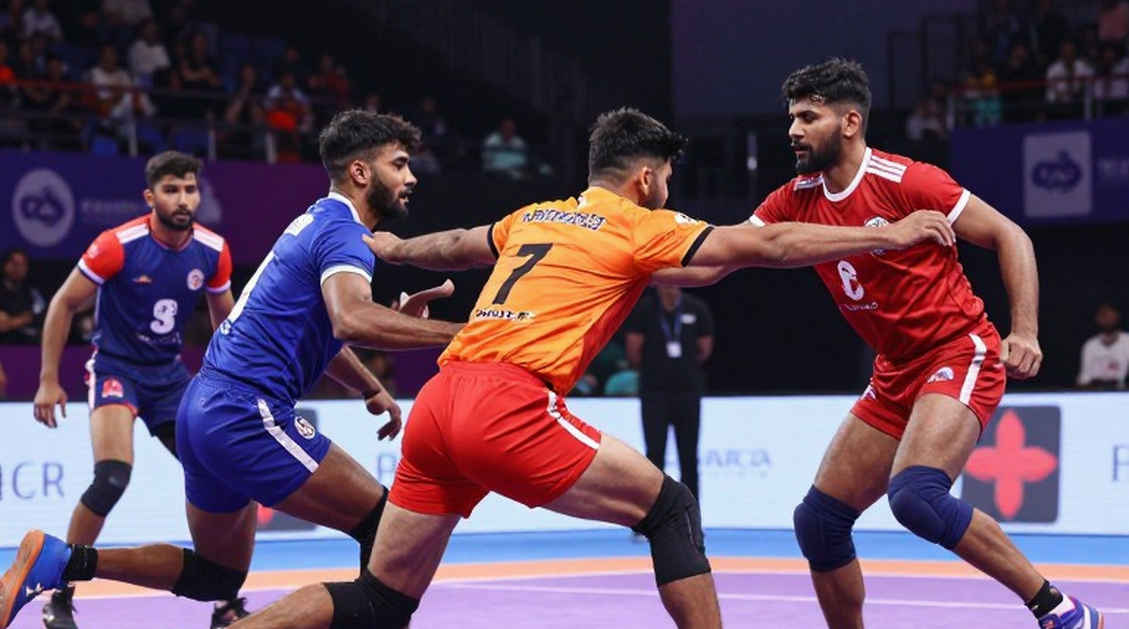
For newcomers, kabaddi's basic mechanics are relatively straightforward. In the standard style, each team has seven players on court. A raider enters the opposition half, attempts to touch defenders and must return safely within a 30-second raid period. The raider continuously chants the word kabaddi during the raid. Defenders score by stopping the raider, while successful touches, bonus-line points, super tackles and all-outs create the sport's distinctive scoring patterns.
The rules provide a familiar technical foundation for players accustomed to international kabaddi and the Pro Kabaddi League. However, organisers should clarify the applicable provisions concerning video reviews, substitutions and other recent rule changes. The available tournament announcement does not explicitly identify the playing variant. Standard style is a strong inference, but the official rulebook should determine the final classification.
The first major competitive challenge is the gap between India and the rest of the field. Indian players regularly experience demanding matches through domestic championships and the Pro Kabaddi League. Their raiders are accustomed to making rapid decisions, reading defensive formations and collecting bonus points. Several participating countries, meanwhile, are still developing their institutional structures and player pools. Playing under the same rules does not automatically create equal competition.
Surjeet Singh will captain India's men's team, with Naveen Kumar appointed vice-captain. Nidhi Sharma will lead the women's team, while Ritu will serve as vice-captain. These appointments establish the leadership structure, but the names alone cannot provide a reliable assessment of tactical strength. Surjeet Singh is a common name in Indian kabaddi, and his precise playing identity should be verified against the official squad list. Naveen Kumar's association with the professional league is notable, but his tournament role and current performance figures also require confirmation.

In my years of watching matches, one recurring lesson has been that strong teams are rarely defined by their raiders alone. Defensive coordination, communication between covers and corners, and the ability to recover after an unsuccessful raid often determine the outcome of close contests. India will need those qualities as well. If opposing teams defend deep and remain disciplined, the Indian raiders will have to rely on patience and collective understanding rather than individual touches alone.
The tournament's rules could make the competitive gap more visible. A bonus point is available when a raider crosses the bonus line while the defending team has at least six players on court. Strong raiding sides can exploit this rule to accumulate relatively low-risk points against inexperienced defences. A successful super tackle with three or fewer defenders earns two points. The do-or-die rule also prevents teams from endlessly avoiding attacking risks: after two consecutive empty raids, the third raid becomes compulsory, and another unsuccessful attempt eliminates the raider.
The schedule provides a useful way to assess the tournament's structure. If the 13 men's teams are divided into groups of seven and six, the group stages would produce 21 and 15 matches respectively. Adding two semifinals and a final brings the total to 39. The women's schedule of 23 matches also fits a 10-team structure divided into two groups of five, producing ten matches in each group and three knockout matches. This arithmetic suggests that approximately ten of the 13 participating countries are entering women's teams.
That difference reveals an important challenge for women's international kabaddi. India has enjoyed considerable success in women's kabaddi at the Asian Games, but the international participation base remains narrower than the men's field. Four Asian Games gold medals have demonstrated the strength of India's women's programme. However, women's kabaddi still lacks a professional franchise structure comparable to the men's league. The Ahmedabad event therefore matters because it can provide female athletes from different countries with an international competitive platform.
The 23-match women's schedule is a positive institutional signal. Its long-term value, however, will depend on whether participating nations continue sending teams, whether players receive adequate training opportunities and when the next international competition takes place. One championship cannot establish a sustainable women's competition structure. Regular fixtures and accountability from national federations will be essential.
The tournament runs from October 23 to 31, with semifinals on October 30 and finals on October 31. Scheduling 62 matches across nine days means approximately seven matches per day. That requires multiple courts, sufficient medical support and sensible recovery arrangements. Teams with limited sports-science resources may face additional soft-tissue injury risks due to travel, demanding conditions and repeated competition.
India's management will also need to consider workload distribution. Giving every leading player a heavy workload during the group stage may be unnecessary. Testing available combinations, assessing defensive partnerships and managing recovery could prove more valuable before the knockout rounds. This is a potential tactical requirement rather than a confirmed selection policy.
The championship also has a substantial promotional dimension. At the curtain-raiser, organisers unveiled the Indian teams' jerseys, captains, vice-captains, official anthem, logo and mascot. AKFI general secretary Jitendra Pran Singh Thakur described the event as a proud moment for Indian kabaddi. IKF general secretary Tejasvi Gehlot called it an important step towards expanding the sport's international presence. Free spectator entry, alongside coverage on JioHotstar and Star Sports, is intended to attract a wider audience.
However, promotional visibility and competitive development are different measures. Attractive branding and television coverage cannot independently increase the international depth of a sport. Countries with developing kabaddi programmes need trained coaches, regular domestic competitions, qualified referees and effective talent-identification systems. The participation of Nigeria, Kenya, Uganda and Canada is particularly interesting in this context. Their performances should not be judged exclusively by the final score against India. Defensive organisation, decision-making under pressure and the ability to sustain effective raids will provide more useful indicators of progress.
Kabaddi's potential inclusion in the 2030 Commonwealth Games is the championship's biggest long-term ambition, but hosting an event in Ahmedabad does not guarantee selection. Multi-sport programme decisions involve considerations such as geographical representation, credible men's and women's participation, administrative stability, broadcast potential and the practical requirements of staging competition. The inaugural championship can provide useful evidence on these issues. The eventual decision, however, rests with the relevant Commonwealth sporting institutions and their programme-selection process.
There is another contradiction worth considering. Kabaddi's deepest roots in India remain in rural Haryana, Punjab and western Uttar Pradesh, while much of its modern visibility comes through television and franchise competition. International expansion should not weaken the domestic ecosystem that produces its talent. Village tournaments, state championships and opportunities for women players remain essential foundations. If resources flow primarily towards major events and promotional campaigns, the development structure could become unbalanced.
For me, the most useful story in Ahmedabad will extend beyond the possibility of another Indian title. Will participating teams receive regular international fixtures over the next two years? Will African and Oceanian countries establish stronger domestic leagues? Can the women's field expand from ten teams to include all 13 participating nations? Will organisers publish transparent information about player performances, injuries, match competitiveness and attendance?
Medals alone are insufficient to measure progress. Successful raid rates, tackle effectiveness, score margins and competitive balance between countries will also matter. Every statistic should be published with its sample size and context. A single tournament cannot establish a country's long-term competitive capacity. A spreadsheet can contain a column for almost everything except the noise created inside a stadium during a decisive raid. Good analysis must read the numbers alongside that experience.
The first Commonwealth champions in both categories will be crowned on October 31. India will be expected to perform strongly on home ground, but the championship's greater achievement will be measured by whether the other participating nations return better prepared for the next edition. The road to 2030 cannot be built through one tournament. It requires regular fixtures, qualified coaches, opportunities for women athletes and domestic competitions that continue long after the closing ceremony. Kabaddi's next important raid must travel beyond Ahmedabad to countries where the sport is still developing its first strong institutional foundations.